The journey / Photography & analysis
Beyond the Sandhills steps
The bridge gets us off the platform. What gets a growing waterfront moving?
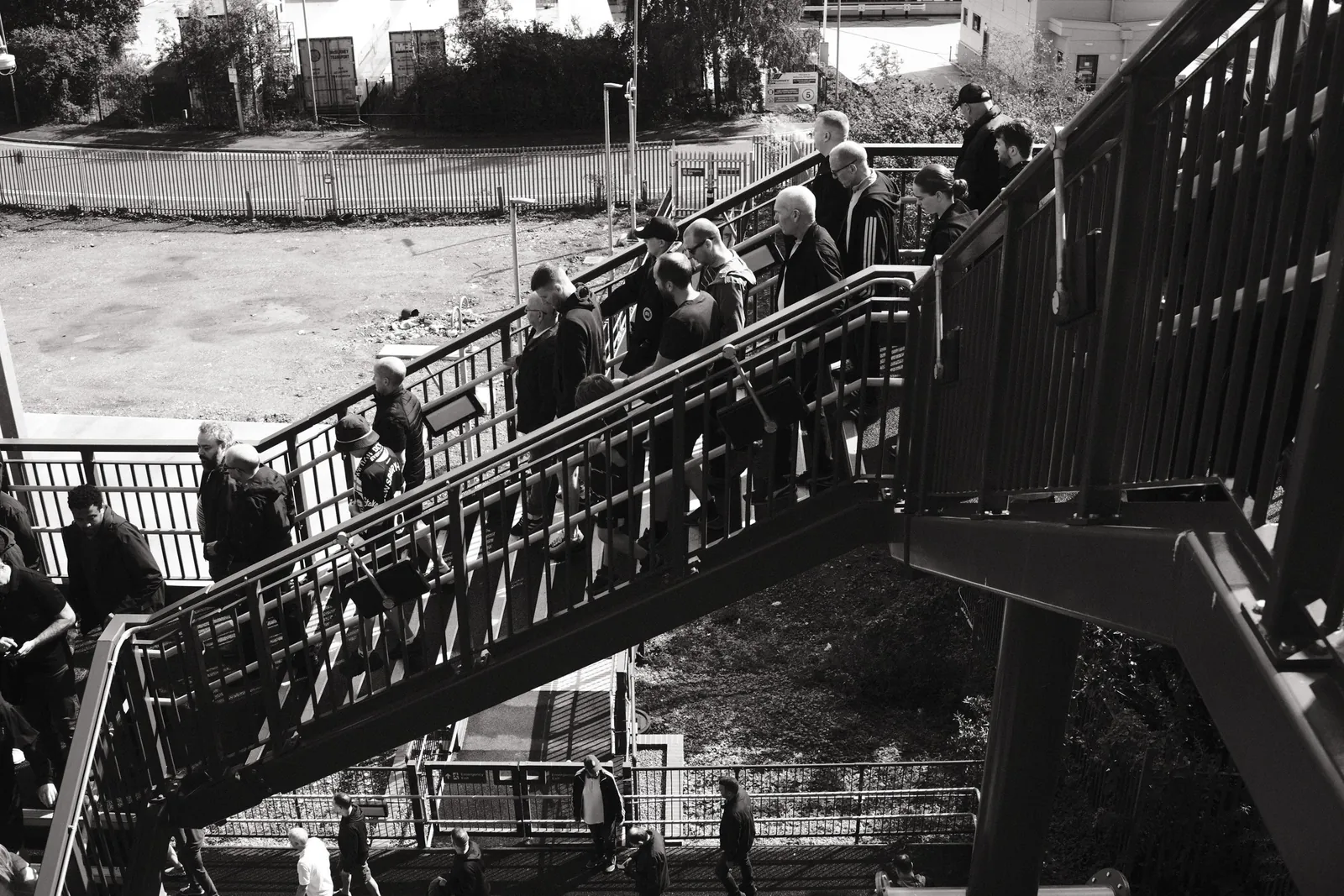
Mark’s photograph catches part of a matchday that rarely makes the highlights: supporters coming down the new Sandhills steps, heading for Bramley Moore. The bridge is a visible improvement. The harder question comes after the final whistle: how easily does everyone get home?
There has been investment. There are also gaps, particularly for people waiting for trains, passengers who need assistance and residents whose normal journeys are disrupted. With homes and a park taking shape along the docks, this needs to become a better everyday route as well as a better way to the match.
Research checked 21 October 2026. The waterfront connection below is our proposal for discussion; approved work and published targets are identified separately.
What was built
Sandhills’ second entrance and pedestrian bridge were open before the first Premier League game at the new ground in August 2025. Merseyrail’s opening-season arrangements also included extra services and longer trains where available. Merseyrail’s announcement
Contractor Morgan Sindall describes six flights of stairs linking the platform and crowd-management area, with strengthening work to the existing brick arch. Installing that connection in a working station was a substantial job. The bridge works
The council improved lighting and signs on walking routes, added directions for shuttles and taxis, and revised parking arrangements after local feedback. Council update, July 2025
There are now four matchday shuttle routes serving the city centre, Bootle and Kirkby, plus an advance-booked accessible shuttle from Sandhills. The cross-river ferry lands at the Pier Head, leaving a walk to the ground. Check the operators’ advice for the particular match. Merseytravel guide, updated 16 October 2026
More room to wait. The same train service.
On 22 September 2026, Liverpool’s planning committee approved a larger Sandhills queuing area, a bus interchange stop and better toilets. The vote was four to one. The minutes record approval, not completed construction. Committee minutes, item 35
The officer report says the scheme would not change the enhanced matchday train service or waiting times. It would bring more of the queue into a managed area, away from Sandhills Lane.
The report gives 49 of 53 trains in use and an aggregate capacity of 15,552 passengers an hour from Sandhills. These are reported applicant figures. The main queue would remain uncovered, citing emergency access, future rail-replacement use and staff visibility. Existing ramps and the lift serve passengers unable to use the stairs. Sandhills planning report, sections 2–4
Moving a queue out of the road is worthwhile. It still leaves the question of how quickly people can board the train they need. A space on a city-bound service does nothing for someone waiting for Southport. Figures by destination, including missed boardings and waits after the busiest games, would tell supporters much more.
Comfort matters too. Shelter, toilets, somewhere to rest and a clearly marked assistance point should be part of the journey. Emergency access needs protecting, but it is worth testing where shelter could fit. An accessible route also needs a workable backup when a lift fails.
The waterfront needs a daily service
At the July 2026 transport committee, a resident raised the loss of the normal number 2 bus route on event days. The chair acknowledged the effect of road closures and said alternatives were being examined. A question about a station near Stanley Dock brought a response that further rail expansion remained under review. Public questions and responses, 16 July 2026
Residents should still be able to get home when Everton are playing. Workers need a useful service when the stadium is quiet. Both belong in the transport plan.
Central Docks is preparing for around 2,350 homes and a five-acre park. Homes England describes a £71 million construction contract within an approximately £81 million infrastructure project. The park and infrastructure target is late spring 2028. Homes England’s announcement
Peel’s October 2026 update shows drainage, paths and bridge works progressing; its current FAQ retains the spring 2028 park target. Construction update · Project FAQ
The wider North Docks programme could eventually accommodate up to 17,000 homes. The proposed Mayoral Development Corporation was still going through the statutory process in September. That wider figure overlaps existing schemes; it is not another 17,000 homes to add to Central Docks. Council’s North Docks update
A waterfront service could connect those neighbourhoods with jobs, the park, ferries, museums, the arena and Everton. Visitors would enjoy the ride. Residents would give it a purpose throughout the week.
Where Baltic fits
Liverpool Baltic is a planned Northern Line station. The April 2025 planning announcement gave an end-2027 opening target; the current forward decision record lists its full business case for 6 November 2026. It is not open, and that earlier target remains a target. Planning announcement · Business-case decision record
A connection there could link a waterfront route to Merseyrail. The transfer would need to be short and step-free, and offer journeys that improve on the existing Northern Line.
An Overhead for today?
Imagine arriving at Moorfields, joining a waterfront line and heading towards Bramley Moore with the river and dock buildings in view. Extend it south to Baltic and the arena, and the journey could become part of a visit to Liverpool.
The idea draws on two separate histories. The dockside Liverpool Overhead Railway—the Dockers’ Umbrella—ran from 1893 to 1956. Exchange was a different railway terminus; its northern services later moved through the underground connection at Moorfields. A new line could acknowledge both without claiming to reopen a single old route. Science Museum Group: the Overhead · National Railway Museum: Exchange and the Link
A route idea for discussion
Places a waterfront line could connect
This is a sketch of connections, not a surveyed route or agreed stops.
- Baltic TriangleConnection to the planned station.
- Arena & south docksEvents and workplaces.
- Pier Head & city centreFerries, museums and James Street.
- Princes Dock / business districtA connection inland towards Moorfields.
- Central Docks & the new parkHomes and public space.
- Stanley Dock / Ten StreetsNeighbourhoods and businesses.
- Bramley MooreThe stadium, with a separate link towards Sandhills to examine.
Moorfields is inland. A short walking and wheeling connection might work better than diverting every waterfront service towards it; a branch is another option. Old railway approaches cannot be assumed to be available. Land ownership, later building and the working railway all need checking.
Elevation would separate vehicles from road traffic and give Liverpool a distinctive ride. It would also mean foundations, columns, lifts, evacuation routes and years of maintenance. Any study needs to address dock walls, heritage settings, buried utilities, wind, noise, station space and a depot.
The original Overhead closed when repairs were judged too expensive. Its successor would need a funded maintenance plan from the start. The Overhead’s history
What are the alternatives?
The Combined Authority already proposes rapid transit inspired by Belfast’s Glider, linking the city centre with North Liverpool, Bramley Moore and the airport. Its £1.6 billion funding announcement covers a regional programme. The earlier ambition to serve the stadiums and airport by 2028 does not establish an agreed waterfront alignment. Funding announcement · Rapid-transit proposal
There are four approaches worth comparing:
- Improve the existing railway. Examine branch capacity, entrances, accessible routes and disruption plans together. A new station may improve access, but does not itself provide more trains.
- Bus rapid transit. Give it road space and junction priority, dependable services and accessible stops. It must still work when matchday closures are in place.
- A surface tram. Test the benefits of a permanent rail route against utility diversions, junction delays and the space needed for pedestrians, deliveries and other traffic.
- An elevated line. Compare the reliable running and visitor appeal against the cost of structures, stations, lifts and long-term upkeep.
Whichever vehicle wins, the fare and timetable need to work for local people. A good view should be a bonus on a useful service.
Start with the journey we have
Publish waits and missed boardings by destination. Review shelter, toilets, lighting and accessible travel with the people who use them. Include evening games, bad weather and disrupted services.
Then commission a waterfront study covering everyday trips as well as match crowds. Bring residents, supporters, disabled travellers, employers and transport staff into it, and protect space for the route as development proceeds.
The club-chaired transport working group already coordinates matchday travel. A wider programme needs the Combined Authority, council, rail partners and developers to set out who will fund, deliver, run and maintain each improvement. Current transport partnership
An elevated waterfront ride deserves a serious look. While that case is tested, supporters and neighbours need a better journey now.
Keep exploring
About this feature
Research checked 21 October 2026; sources are linked beside each passage. Completion of the September-approved Sandhills works has not been verified. The waterfront route is an editorial proposal, not a surveyed, costed or endorsed scheme. Photograph © Mark C Grant.