Waterfront history / Photo story
The Dockers’ Clock
Six faces, a time signal and a working life long before football came to Bramley-Moore.
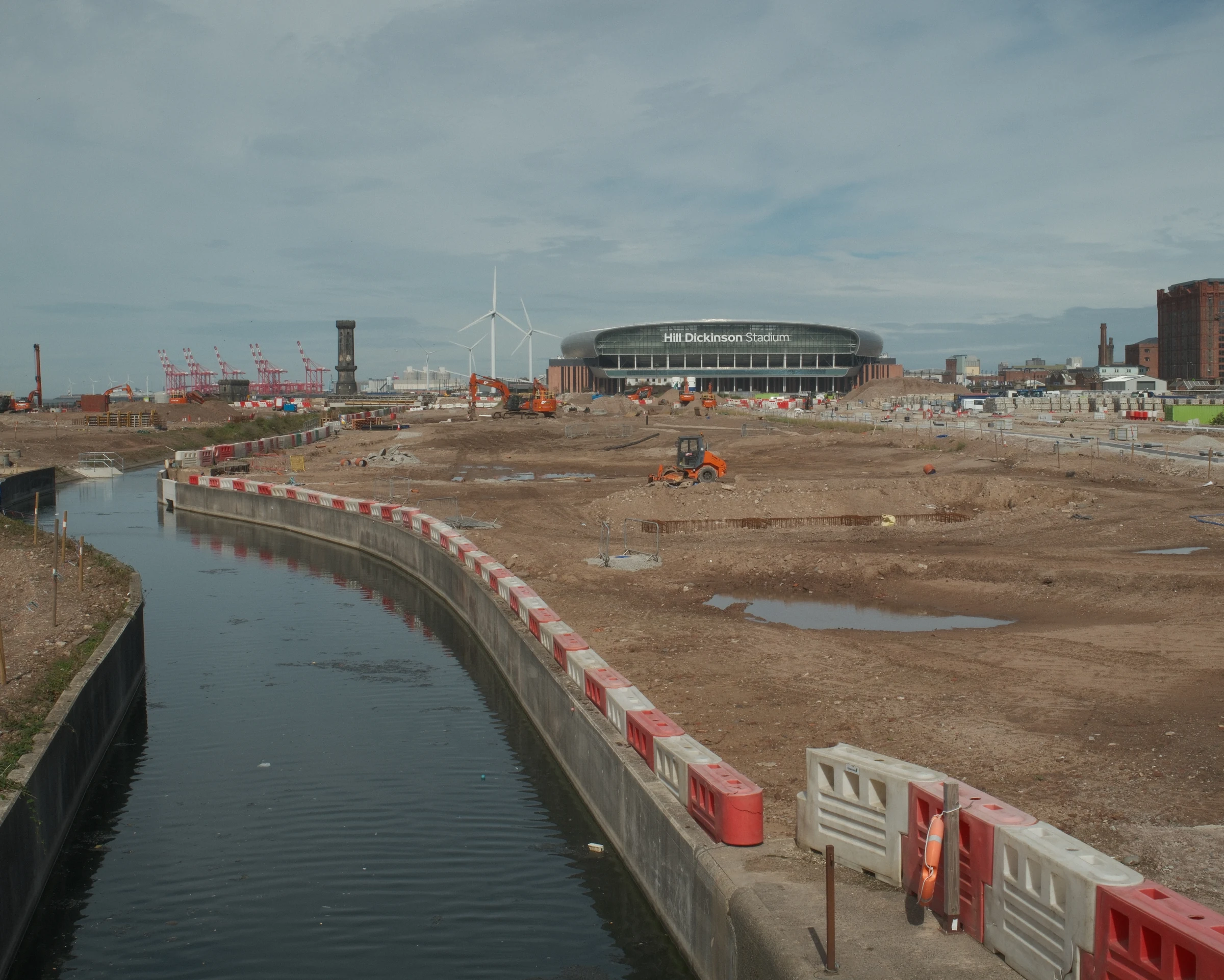
Find the clock tower in the photograph
Look left of the stadium, just to the right of the red dock cranes. The tall stone tower is Victoria Tower at Salisbury Dock. Keeping the wider view shows how it sits in the waterfront landscape; it is easy to lose it in a tight stadium photograph.
The stadium takes most of your attention in this picture. Then, to its left, you spot the older tower: tall, narrow and standing above the dock works. It has a name of its own, Victoria Tower, and a more familiar one—the Dockers’ Clock.
It belongs to Salisbury Dock, south of Bramley-Moore. That matters when you look at the photograph: two landmarks can appear alongside each other without standing on the same site. The tower’s story reaches back to the expansion of Liverpool’s docks in the nineteenth century, when getting the time right was part of running a port.
- Tower built
- 1848
- Clock faces
- Six
- Historic time-ball signal
- 1pm
Why six faces?
Because people needed to read it from different directions. The tower stood on the pier between Salisbury Dock’s two entrances, with clock faces visible to shipmasters on the Mersey and inside the docks. A single face looking out over the river would have left part of its audience behind it. Thomas & Thomas, pp38–40
Historic England dates the granite tower to 1848 and credits dock engineer Jesse Hartley. Its thick base, projecting balcony and battlemented top give it something of a small castle’s appearance. It has been Grade II listed since 14 March 1975. The official listing
There is a useful wrinkle in the dates. Research by Steve and Darlah Thomas found that the Dock Committee agreed to name the tower Victoria ahead of the royal visit in October 1851. Clock tenders were invited then, too. The mechanism subsequently installed was by Whitehurst of Derby. So 1848 dates the building; it should not automatically be used as the date of its clock. The naming and clock tender
When one o’clock was something you could see
The clock later became part of a much bigger timekeeping system. In February 1860 its six dials were electrically connected to the standard clock at Liverpool Observatory. A time ball, made by George Forrester & Co., was installed to fall at 1pm, in step with the Observatory’s own ball.
For someone watching from a ship, that drop supplied a clear moment to check the time. The face could tell you roughly where you were in the hour; the signal supplied the precise instant. It is a wonderful detail to put back into a view of an apparently quiet tower.
By the Observatory’s 1862 report, the hourly strike indicated Greenwich mean time. Signals also travelled back from the tower every minute so its performance could be checked. This was a connected piece of port equipment, with accuracy being monitored at a distance. Schmidt & Dearden, pp89–90
A bell and the Pier Master’s flat
There was more to the building than the clock. Liverpool City Council’s heritage dossier records a bell used for high-tide and warning signals, and a flat for the Pier Master inside the tower. That last detail changes the picture a little: behind the stone and the public faces was somebody’s accommodation, built into the working dock. Liverpool’s nomination dossier, p65
The link with Bramley-Moore
Salisbury and Bramley-Moore were part of the same northern dock expansion. Five docks opened together on 4 August 1848: Stanley, Collingwood, Salisbury, Nelson and Bramley-Moore. The Everton FC Heritage Society identifies Bramley-Moore as the northernmost of the group. The history of Bramley-Moore Dock
That is the connection worth keeping in mind when looking towards Everton’s home. The stadium occupies one part of a waterfront that once worked as a joined-up dock system. The clock, the water and the old masonry help explain the rest of the scene.
Mark’s photograph keeps the building works and the open water in the frame. The clock is quite small, but it gives the view another timescale. A photograph taken for the stadium can also become a record of its surroundings—and those surroundings will deserve another look as they change.
More of the waterfront
Sources and photograph
Historical details checked on 21 October 2026. Photograph © Mark C Grant; date taken from the camera record. Historical timekeeping descriptions do not establish whether the clock works today.
- Historic England: Victoria Tower, list entry 1209989 — building date, attribution, fabric, six faces and listing.
- Mersey Ferries: River Explorer Cruise fact sheet — the Dockers’ Clock name and maritime use.
- Steve and Darlah Thomas: “Getting the right time”, Part 1, Antiquarian Horology, March 2020, pp38–40 — position, naming and the later clock tender.
- Richard E. Schmidt and Paul Dearden: “The Liverpool Observatory at Waterloo Dock. Part 2”, The Antiquarian Astronomer, June 2020, pp89–90 — the 1860 time ball and electrical connection.
- Liverpool City Council: World Heritage nomination dossier, p65 — the bell and Pier Master’s flat; used here as a historical building record.
- Everton FC Heritage Society: The History of Bramley-Moore Dock — the five docks opened in 1848.